

Why Most Tote Mixers Fail in Real IBC Mixing
At first glance, mixing inside an IBC tote seems simple. In reality, it is one of the most misunderstood challenges in industrial mixing. The main limitation comes from a small but critical detail: the standard 2 inch bung opening found on most IBC totes.
This restriction forces many manufacturers to choose tote mixers that can physically fit through the opening, rather than mixers that can deliver effective mixing performance. As a result, businesses often end up with underpowered solutions that struggle to properly mix the contents of the tote.
The consequences are clear: long mixing times, poor re homogenization, material settling at the bottom, and inconsistent product quality.
The Problem with Traditional Tote Mixers
Traditional IBC tote mixers are typically designed as top entry systems that fit through the bung. While they may technically work, they rarely provide full volume mixing.
Because of their limited size and power, these mixers mainly create surface agitation instead of true bulk movement. This leads to inefficient mixing, especially when dealing with viscous liquids, suspensions, or products that tend to separate over time.
For industries that rely on consistency, such as food processing, nutraceuticals, cosmetics, and chemicals, this approach creates operational inefficiencies and quality risks.
A Smarter Approach to IBC Tote Mixing
Instead of trying to force a mixer through a small opening, a more effective solution is to rethink the entire mixing process.
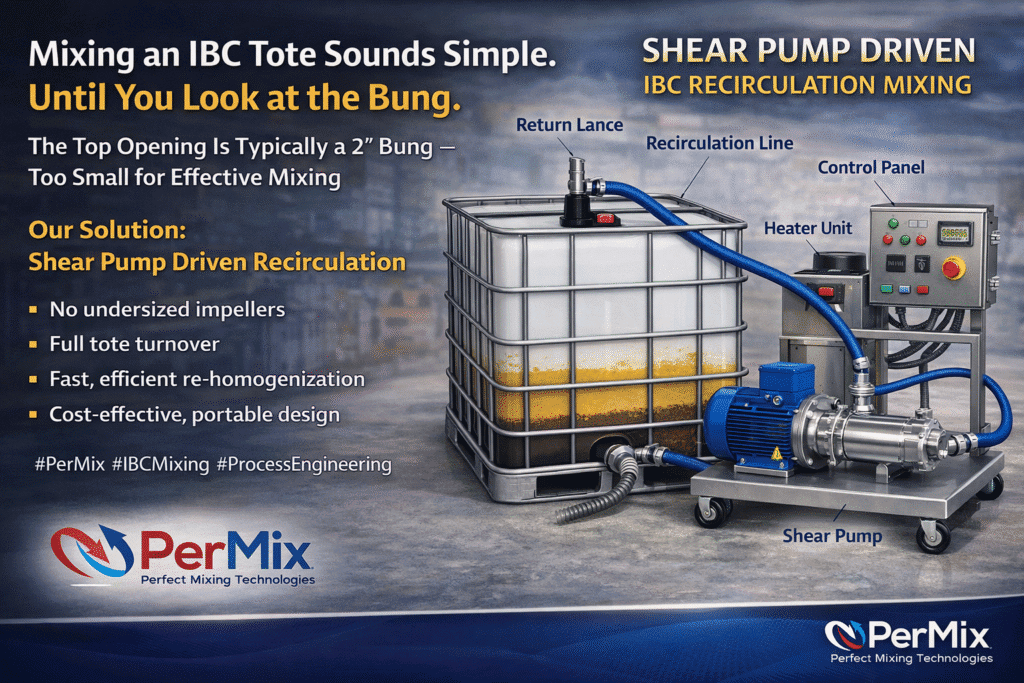
PerMix tote mixers use a recirculation mixing system powered by a shear pump. This method draws material from the bottom outlet of the tote, mixes it actively, and returns it back to the top.
This approach bypasses the physical limitations of the bung and enables full volume mixing across the entire tote.
How Recirculation Tote Mixers Improve Performance
Recirculation based tote mixers provide a significant upgrade in mixing efficiency and consistency.
They allow full turnover of the product inside the tote rather than just surface movement. This results in faster and more uniform mixing, even for challenging materials.
Because the system is not limited by the size of the bung, it delivers stronger mixing performance without requiring any modifications to the tote itself. It is also a cost effective and portable solution, making it ideal for flexible production environments.
Why IBC Tote Mixing Requires a Different Mindset
The key to successful tote mixing is asking the right question. Instead of focusing on what mixer can fit through the bung, manufacturers should focus on what solution will mix the entire tote effectively.
This shift in thinking leads to better process design, improved product quality, and more efficient operations.
Industries That Benefit from Advanced Tote Mixers
High performance tote mixers are especially valuable in industries where consistency and repeatability are critical.
Food and beverage manufacturers rely on them for sauces, liquids, and functional ingredients. Nutraceutical and cosmetic companies use them for precise formulations. Chemical and specialty material producers depend on them for stable and uniform mixtures.
In all these industries, proper IBC tote mixing directly impacts product quality and production efficiency.
Conclusion
Tote mixers should be designed to perform, not just to fit through a small opening. By moving away from traditional top entry limitations and adopting recirculation based mixing, manufacturers can achieve faster, more reliable, and more consistent results.
Effective IBC tote mixing is not about adapting to constraints, but about choosing the right technology to overcome them.